


Ini Spesifikasi Hp Terbaru Realme, Reame 5s
4 years ago
Military bases in Iraq and Afghanistan continue to use waste methods that expose troops to potentially toxic emissions without fully understanding the effects, according to a new government audit obtained by CNN.
Between September 2009 and October 2010, investigators from the Government Accountability Office visited four bases in Iraq and reviewed planning documents on waste disposal for bases in Afghanistan. None of the Iraq bases visited were in compliance with military regulations. All four burned plastic -- which generates harmful emissions -- despite regulations against doing so.
The emissions have been the source of controversy as troops have complained about a host of problems, from cancerous tumors to respiratory issues, blaming exposure to burn pits. Military officials have denied any consequential effects on most troops.
The military, the report concluded, has been slow in using alternatives and has not considered the long-term costs of dealing with subsequent health issues.
The report is expected to be released later Friday.
Prior to an initial outcry about the pits more two years ago, the largest base in Iraq -- Balad Air Base -- was burning everything from hazardous and medical waste to plastics, using jet fuel as accelerant, according to military documents. The smoke poured over the living quarters and the base hospital, exposing thousands of troops to the emissions.
GAO investigators blame the continued burning of prohibited items on the constraints of operating in a war zone, limitations of resources and outdated agreements with waste disposal contractors that do not include the latest regulations on what is safe to burn.
The U.S. military generates about 10 pounds of non-hazardous waste per service member each day and "may consist of plastic, Styrofoam, and food from dining facilities; discarded electronics; shipping materials such as wooden pallets and plastic wrap; appliances; and other items such as mattresses, clothing, tires, metal containers, and furniture," the report says.
According to the report, there were 221 burn pits in Afghanistan by August and more are anticipated. Only 21 remained in Iraq and, like the troop levels there, the numbers are expected to decrease. The burn pits are operated by either the military or contractors.
While the pits have been in use since the beginning of each war, regulations and guidance were only issued in 2009 -- eight years into the Afghanistan conflict and six years after the start of the war in Iraq.
Incinerators and recycling would make for a much safer environment, but to date there are only 20 incinerators in Afghanistan and 41 in Iraq. Military officials complained they "were expensive and posed acquisition, logistic, and operational challenges," according to the report. However, the GAO found that the Department of Defense has little understanding of that cost.
"Our analysis determined that DOD has little information on what it costs to procure, install, operate, and maintain incinerators during contingency operations," said the report.
Additionally, the GAO found that sorting of trash and recycling efforts are only beginning in Iraq and have not been planned for in Afghanistan.
The report notes that the 2009 directive for Afghanistan regarding waste said while burning trash at the beginning of military operations is understandable, "open burning will not be the regular method of solid waste disposal."
A March 2010 military directive allows for burning waste only if the commander determines there is no other feasible method of waste disposal and petitions the Pentagon to do so. GAO investigators noted that as of August 2010, no commander had requested such permission. However, a senior military official told investigators that "information gathered from field commanders led him to conclude that disposal of prohibited items in burn pits had become routine at many bases in Afghanistan and Iraq."
The military's attitude about the impact of the burn pits has shifted. When complaints initially arose in 2008 military officials denied there was any hazard to troops. Last year the Pentagon changed that position, declaring long-term effects for troops who had pre-existing conditions was foreseeable.
Still, the military defends the pits as a necessity, especially at many of the smaller combat outposts where more advanced methods are not feasible or practical. In addition, military officials told the GAO investigators that many of the supplies shipped to the bases are made of or packaged in prohibited materials, creating a greater burden in finding alternative methods to dispose of the materials that continue to pile up.
On two of the bases visited, waste management was handled by a contractor which did not abide by the updated rules because their contract predated the new regulations. In September 2009, the military tried to renegotiate with the contractor to incorporate the more stringent disposal requirements, a process that was ongoing the following summer.
"As of July 2010, DOD and the contractor had yet to finalize this update because the contractor believes the new guidance would require activities beyond the scope of existing contracts that would result in additional costs, and therefore should require a re-negotiation of those task orders," the GAO report said.
Despite regulations by the U.S. Central Command to assess pit emissions, U.S. forces in neither Iraq or Afghanistan have done so in a comprehensive fashion, the GAO report stated.
"The health impacts of burn pit exposure on individuals are not well understood, mainly because the military does not collect required data on emissions or exposures from burn pits," according to the report.
"Thousands" of samples have been collected by medical personnel, though military officials said it is difficult to determine if the captured air is truly from the burn pit or another source in the vicinity, like an industrial site.
A GAO analysis of the data from the samples collected found matter named on the CENTCOM list of potentially harmful substances. Investigators found that the samples which exceeded the levels considered safe if exposed for a year mostly contained fine particles. Fine particles can embed in the lung tissue, and of particular concern is when there is prolonged exposure.
Sen. Russ Feingold, D-Wisconsin, who has been vocal in his concern about troops' exposure to burn pits, urged the Pentagon to restrict the use of the pits in Afghanistan.
"I am deeply troubled to learn that the Defense Department has not taken simple steps, such as segregating plastics, to ensure that our troops are not exposed to harmful emissions," Feingold said in a statement released Friday.
The acting commander of Central Command, Lt. Gen. John Allen, wrote a letter to Feingold in July saying the military is trying to eliminate the use of burn pits at bases that are active for 90 days or more and occupied by 100 personnel or more. In Iraq, Allen anticipates there will be no burn pits by December of this year. Afghanistan is more challenging, but the military is in the process of procuring "almost 200 incinerators," he said in the letter, obtained by CNN.
The military, Allen wrote, continues "to evaluate potential health outcomes in Service Members who have deployed" and he promises an improvement in air sampling collection
A preliminary injunction against Target Corp. alleges that the retail chain illegally disposed of hazardous consumer products that were returned or damaged, Los Angeles and state prosecutors said Monday.
The order issued Friday by Alameda County Judge Steven A. Brick prohibits Target from engaging in practices that violate California environmental laws, said officials with the L.A. city attorney's office. Prosecutors also are seeking civil penalties against the Minneapolis-based company.
Specifically, the company was ordered not to dispose of hazardous waste at an unauthorized or unpermitted place nor transport hazardous waste to an unpermitted facility, among other rules.
There are about 200 Target stores and seven distribution centers in California, including about 50 in the city and county of Los Angeles, prosecutors said.
Company officials could not immediately be reached for comment.
Prosecutors said the stores carry hundreds of items that pose environmental hazards, including bleach, paint, pesticides, aerosols, oven cleaners and automotive products. State environmental law strictly governs their disposal.
Investigators with the state attorney general's office and the Los Angeles city attorney's office say the company did not abide by those rules.
The investigators said they found in January 2008 that 5,000 pounds of products that could not be sold were sent by L.A.-area stores to the Los Angeles Regional Food Bank. According to investigators, the shipments included "damaged, leaking, unusable items with flammable, toxic and corrosive properties."
Last March, the attorney general, the Los Angeles city attorney and district attorneys from across the state launched an investigation that uncovered what officials described as ongoing violations of the state's hazardous-waste laws.
-- Andrew Blankstein

Until recently, it was easy to turn a blind eye to electronic waste (e-waste). It used to be that once old and broken computers, televisions and all sorts of consumer electronics where shipped overseas, it was out of sight and out of mind. But now, thanks to some high-profile investigative reports and images like these from The New York Times Magazine, the devastating effect of e-waste on developing nations is getting tougher to ignore.
Businesses, in particular, should take heed. Besides being good corporate citizens and preventing scenes like these from playing out in the developing world, responsible and secure electronics recycling and e-waste handling helps prevent costly security and compliance breaches. And it’s not just old PCs and servers that can spill secrets, photocopiers can too. And don’t worry if you can’t do it in-house; there are plenty of recyclers and data-wiping experts — sometimes one and the same — that can get you on the right track.
I encourage you to take a look at the NYT gallery and keep those images in mind when you’re faced with the decision to recycle your electronics or simply toss them away.
Gallery (and image credit): A Global Graveyard for Dead Computers in Ghana – The New York Times Magazine

Workers dismantle old computers and electronics at E-Parisara, an electronic waste recycling factory, 28 miles from Bangalore, India. Click to enlarge this image.
Uriel Sinai/Getty Images
You have no doubt seen images like the following: an Asian child sorting through in a pile of junk electronics, a young Nigerian burning bundles of copper wires, an Indian woman soaking circuit boards in acid.
It’s a fact that computers and other electronics are often exported from rich countries to be recycled in China, India, Thailand and Nigeria by unregistered business operations (“backyard”) that use primitive recycling process. The hazards are serious. The mere presence of these goods can contaminate the air, water and soil. Wire burning emits dioxins and other pollutants; acids can burn.
Backyard recycling is a clear and present danger, and given increased use of electronics around the world, the problem appears slated to get worse without public response.
The prevailing solution bandied about by many is to ban the trade in end-of-life electronics. In fact, the European Union has banned exports of end-of-life electronics. The U.S. Congress is currently considering H.R. 2595, a bill that would ban the export of end-of-life electronics from the United States. China, India and Indonesia have largely banned imports of used and scrap electronics. And some countries such as Thailand and Mexico only allow imports of used electronics.
But contrary to popular belief, banning electronic waste is not the answer, and here are three big reasons why:
1. Trade bans have negative economic and social impacts by cutting jobs in the refurbishment sector and reducing supply to used markets.
Many people in the developing world make a living from fixing and selling used electronics. Not only is this a source of employment where it is greatly needed, but it also increases access to computers and other electronics that play an important role in the development and education of poor people.
Some export bans such as H.R. 2595 in the United States require that electronics are refurbished in the developed world, making used electronics prohibitively expensive for many, and closing down refurbishment businesses in the developing world.
2. Trade bans push the backyard recycling towards the black market.
While China officially banned imports of end-of-life electronics in 2002, smuggling has replaced official trade and electronics reportedly continues to flow into the country much as before the ban. Substantial amounts of end-of-electronics are still exported from Europe, partly through internal trade within Europe to areas with lax enforcement.
The enforcement challenge also increases the involvement of organized crime. In 2002 members of U.S. environmental NGOs visiting the Chinese town of Guiyu, an informal recycling center, were free to walk the village and interview local workers. Since the ban organized crime has become involved and reporters visiting the town are now driven out.
3. Within a decade, more e-waste will be generated in the developing world compared to the developed, waste that without other interventions will be recycled with high environmental impacts.
The underlying premise of a trade ban is that imports from the developed world are the main problem. But research conducted by myself and my colleagues shows that by around 2016, the developing world will generate more waste computers than the developed world. Global volumes of computer e-waste are expected to triple between 2010 and 2025 and by around 2025, the developing world will generate double the developed world’s waste computers. Not surprisingly, developing Asia, due to its high population and rapid growth, is a major contributor to this future waste stream.
Export bans will not only fail to solve the problem of informal recycling, but also cause negative impacts on vulnerable people in the developing world. A broader policy agenda is needed. Surprisingly, there has been no official policy action to directly clean up the impacts of backyard recycling.
One option could be to divert recycling fees in order to pay backyard recyclers to turn in components that are dangerous to process. The United States and other rich countries have a role to play in providing financial and technical support.
Eric Williams is a professor in the department of civil and environmental engineering in the School of Sustainability at Arizona State University in Tempe. He helps run the IT and Environment Initiative and has testified at a hearing on e-waste held by the U.S. House Committee on Science and Technology. His views are not necessarily the views of Discovery News.
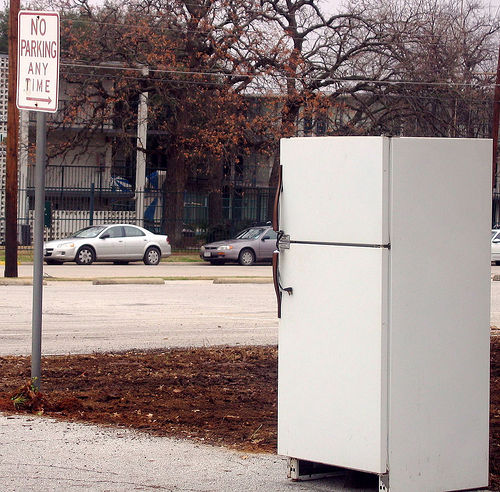
Need a new refrigerator? The Cash for Appliances program is still in affect, and many states still have available funding. Photo: Flickr/Rich Anderson
After making headlines earlier this year, the government’s energy efficient appliance rebate program is still largely in effect in most states and hasn’t even began yet in others.
Dubbed “Cash For Appliances,” the program provides rebate incentives for purchasing energy efficient Energy Star appliance models. Unlike it’s “clunker” predecessor, this program does not require turning in an older model appliance to receive the rebate.
Though some states have allocated all their available funding, 36 states and territories still have funding as of June 2. In addition, certain states are beginning second and third phases of their rebate programs, expanding the list of qualifying products and offering additional rebates.
State funding ranges from $100,000 in the U.S. territories of American Samoa and Northern Marianas Islands to $35,267,000 for California. And qualified appliances range from three products (refrigerators, clothes washers and room air conditioners) in California to fifteen different eligible products in Georgia.
According to the Department of Energy and the New York State Energy and Research Development Authority, New York’s rebate program alone will help save residents $6 million in annual energy and water utility costs and $33 million over the lifetime of the products.
Rebates for appliance upgrades are distributed in the form of a Visa prepaid card, which local commerce departments hope will encourage consumer spending at local restaurants and retail locations.
To check whether your state still has available funding, which appliances are eligible for rebates in your state and to view a summary of each state’s rebate program, visit the Department of Energy.
Related articles
Cash for Appliances is Official
GE Breaks Down Energy Cost of Home Appliances
...and not with Windex.
Along the lines of the e-waste and regulatory compliance issues I've posted about in the past, companies would do well to give the same care and attention to their copiers that they devote to their PCs and servers. Copiers, it turns out, do much more than churn out paper copies. They store document images on their internal hard drives to speed up performance, sometimes indefinitely.
The problem is that many organizations aren't taking the time to wipe those hard drives when they dispose of their copiers, many of which end up in the used business equipment market. As you can see in this CBS News video, used copiers can fetch a couple hundred dollars. Now think about all the businesses and government agencies that handle private data (doctor's offices, insurance companies, police stations, and so forth...) and you can see why criminals might think nothing of parting with a few Benjamins for a shot at a treasure trove of personal data that can net them much, much more. Or they can skip the buying a used copier altogether and pry the hard drives of retired copiers sitting in a storage area, or worse, the brazen ones might snatch the drives from actively used models. This data security hole is so potentially damaging that the FTC has now taken an interest.
So a word of advice: treat copiers like other IT equipment (many are sophisticated enough to qualify) and make sure that their hard drives are completely wiped before they're disposed of.


